


Debt Structuring: A Critical Component of CRE Financing
Commercial real estate financing isn’t just about securing capital—it’s about structuring that capital in a way that maximizes returns while minimizing risk. As someone who’s spent years navigating the complex world of CRE transactions, I’ve witnessed firsthand how proper debt structuring can make or break a deal. Whether you’re a seasoned investor or just stepping into commercial real estate, understanding the nuances of debt structuring is essential for long-term success.
Think of debt structuring as the architectural blueprint of your financing strategy. Just as you wouldn’t build a skyscraper without carefully planned engineering, you shouldn’t pursue commercial real estate investments without a well-thought-out debt structure. The way you arrange your financing can significantly impact your cash flow, tax obligations, and overall investment performance.
Understanding the Fundamentals of Commercial Real Estate Debt Structuring
Debt structuring in commercial real estate involves organizing various forms of debt capital to optimize the financial performance of a property investment. Unlike residential real estate, where financing options are relatively straightforward, commercial properties offer a complex array of debt instruments that can be combined and layered to achieve specific investment objectives.
The primary goal of effective debt structuring is to balance leverage with risk while maximizing returns on equity. This delicate balance requires careful consideration of factors such as interest rates, loan terms, repayment schedules, and covenant requirements. Smart investors understand that the cheapest debt isn’t always the best debt—sometimes paying slightly higher rates for more flexible terms can prove invaluable down the road.
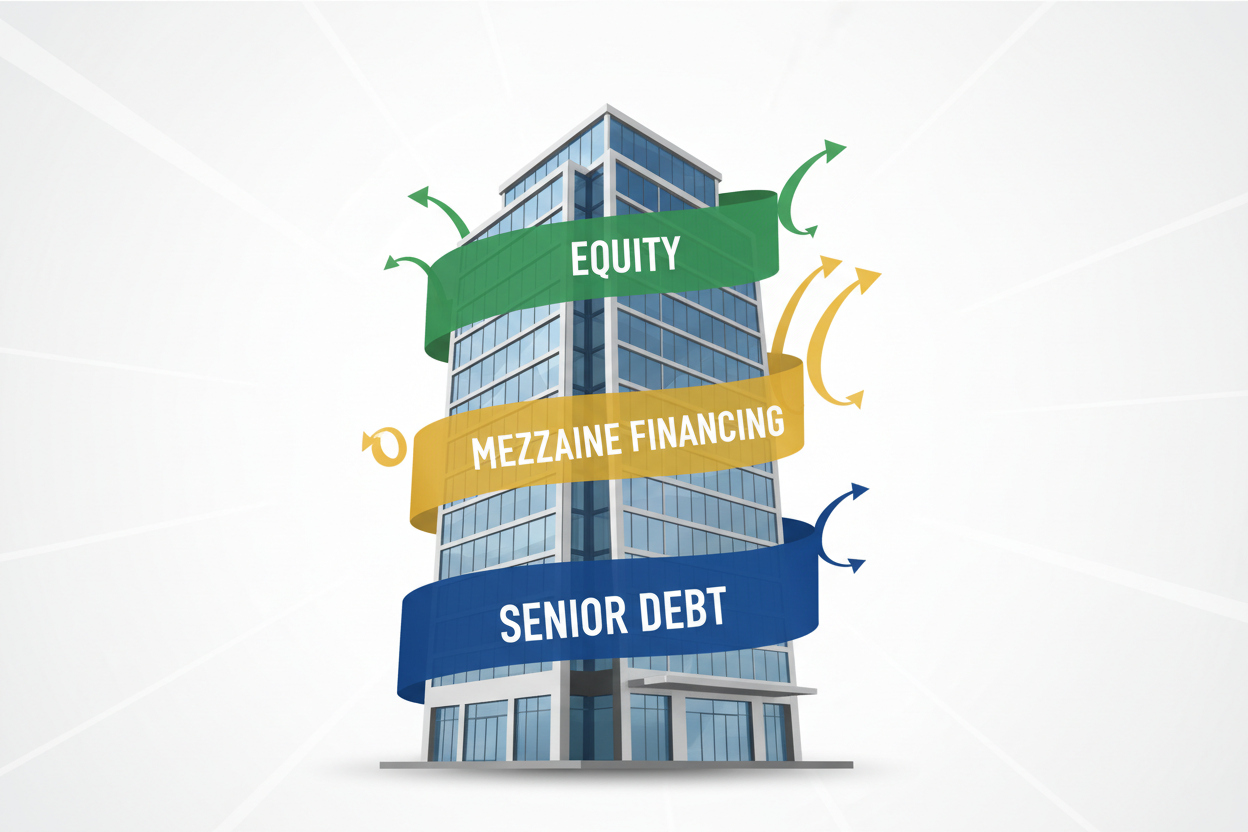
Commercial real estate debt typically falls into several categories, each serving different purposes within an overall financing strategy. Senior debt forms the foundation, usually representing 60-80% of the property value. Mezzanine financing fills the gap between senior debt and equity, while bridge loans provide short-term solutions for acquisitions or repositioning strategies.
Types of Debt Instruments in Commercial Real Estate
The commercial real estate financing landscape offers numerous debt instruments, each with unique characteristics and applications. Traditional bank loans remain the most common form of senior debt, offering competitive rates but often requiring strong borrower credentials and conservative loan-to-value ratios.
CMBS (Commercial Mortgage-Backed Securities) loans have gained popularity for their competitive pricing and longer-term stability. These loans are packaged and sold to investors, which can provide borrowers with attractive terms but may limit flexibility during the loan term. The standardized nature of CMBS loans makes them ideal for stabilized properties with predictable cash flows.
Life insurance companies represent another significant source of commercial real estate debt, particularly for high-quality properties in prime locations. These lenders typically offer longer-term financing with competitive rates, though they often have stringent underwriting requirements and prefer borrowers with strong track records.
For more complex transactions or value-add strategies, mezzanine financing provides additional capital beyond traditional senior debt. This form of financing typically carries higher interest rates but offers more flexibility and can bridge the gap between debt and equity financing. Mezzanine lenders often participate in the upside potential of a project through equity participation or conversion features.
Key Factors Influencing Debt Structure Decisions
Several critical factors influence how commercial real estate professionals structure their debt packages. Property type plays a fundamental role, as different asset classes carry varying risk profiles and cash flow characteristics. Office buildings, retail centers, industrial properties, and multifamily developments each present unique financing considerations that impact optimal debt structuring.
Market conditions significantly affect debt structuring decisions. During periods of tight credit markets, borrowers may need to accept higher leverage costs or more restrictive terms. Conversely, favorable market conditions might allow for more aggressive structuring with higher loan-to-value ratios and more flexible terms.
The borrower’s experience and financial strength also heavily influence available debt options. Established developers and investors with strong balance sheets can access more favorable terms and a broader range of financing sources. First-time commercial real estate investors may need to accept more conservative structures or provide additional guarantees to secure financing.
Investment strategy represents another crucial consideration. Value-add projects requiring significant capital improvements may benefit from construction-to-permanent financing or bridge loans that provide flexibility during the repositioning phase. Conversely, core investments in stabilized properties might favor long-term, fixed-rate financing to provide predictable cash flows.
Risk Management Through Strategic Debt Structuring
Effective debt structuring serves as a powerful risk management tool in commercial real estate investing. By carefully selecting debt instruments and terms, investors can mitigate various risks while optimizing returns. Interest rate risk, for instance, can be managed through fixed-rate financing, interest rate caps, or swaps that provide protection against rising rates.
Refinancing risk poses another significant concern, particularly for shorter-term debt instruments. Staggering debt maturities across a portfolio can help reduce concentration risk and provide more flexibility when refinancing becomes necessary. Some sophisticated investors intentionally structure debt with different maturity dates to take advantage of varying market conditions over time.
Recourse versus non-recourse debt represents a critical risk consideration. While recourse debt may offer more favorable terms, it exposes borrowers to personal liability beyond the property itself. Non-recourse financing limits liability to the property but typically comes with higher rates and more restrictive terms. The choice between these options depends on the borrower’s risk tolerance and overall financial situation.
Cash flow volatility can be managed through debt structuring techniques such as interest-only periods, graduated payment schedules, or cash flow sweeps that adjust payments based on property performance. These features can provide breathing room during lease-up periods or economic downturns while ensuring adequate debt service coverage during strong performance periods.
The Role of Loan-to-Value Ratios and Debt Service Coverage
Loan-to-value ratios and debt service coverage ratios form the backbone of commercial real estate underwriting and significantly impact debt structuring decisions. LTV ratios determine how much debt can be placed on a property relative to its value, while DSCR measures the property’s ability to service its debt obligations.
Most commercial real estate lenders require minimum DSCR of 1.20 to 1.25, meaning the property must generate at least 20-25% more cash flow than required for debt service. Higher-quality properties and stronger borrowers may qualify for lower DSCR requirements, while riskier investments may require ratios of 1.35 or higher.
Understanding these metrics allows investors to optimize their debt structuring by balancing leverage with coverage requirements. Sometimes, accepting slightly lower leverage can result in more favorable terms that ultimately improve overall returns. The key is finding the sweet spot where maximum leverage meets acceptable risk parameters.
Lenders also consider debt yield, which measures net operating income against the total loan amount. This metric provides another layer of protection for lenders and helps determine appropriate loan sizing. Typical debt yield requirements range from 8% to 12%, depending on property type and market conditions.
Impact of Market Cycles on Debt Structuring Strategies
Commercial real estate markets are cyclical, and successful debt structuring requires understanding how these cycles affect financing availability and terms. During expansionary periods, lenders become more aggressive, offering higher leverage and more flexible terms. These conditions create opportunities for borrowers to secure favorable financing, but they also require discipline to avoid over-leveraging.
Conversely, during market contractions, credit tightens and lenders become more conservative. Borrowers may face lower loan-to-value ratios, higher debt service coverage requirements, and more restrictive covenants. Anticipating these cycles and structuring debt accordingly can provide significant advantages.
Experienced investors often structure their debt to mature during favorable market conditions when refinancing options are more abundant. This forward-thinking approach requires careful timing and market analysis but can result in substantial savings and improved investment performance.
The COVID-19 pandemic provided a stark reminder of how quickly market conditions can change. Properties with conservative debt structures and strong cash flow coverage weathered the storm much better than highly leveraged investments. This experience reinforced the importance of maintaining adequate financial cushions even during seemingly favorable market conditions.
Best Practices for Optimizing Commercial Real Estate Debt Structure
Successful debt structuring requires a comprehensive approach that considers both current conditions and future scenarios. Start by clearly defining your investment objectives and risk tolerance. Are you seeking maximum leverage to enhance returns, or do you prioritize stability and cash flow protection? Your answers will guide the structuring process.
Diversification applies to debt structuring just as it does to investment portfolios. Consider using multiple lenders or debt instruments to reduce concentration risk and increase flexibility. This approach may require more effort but can provide valuable options during challenging market conditions.
Timing plays a crucial role in debt structuring success. Monitor interest rate trends and credit market conditions to identify optimal financing windows. Sometimes waiting a few months for better conditions can result in significant savings over the loan term.
Work with experienced professionals who understand the nuances of commercial real estate financing. Mortgage brokers, attorneys, and financial advisors can provide valuable insights and help navigate complex structuring decisions. Their expertise often pays for itself through improved terms and avoided pitfalls.
Finally, maintain flexibility wherever possible. Markets change, and investment strategies evolve. Debt structures that provide options for early repayment, assumption by buyers, or modification can prove invaluable as circumstances change.
Frequently Asked Questions
What is the typical loan-to-value ratio for commercial real estate financing?
Most commercial real estate loans range from 60% to 80% LTV, depending on property type, location, and borrower strength. Stabilized properties in prime locations may qualify for higher leverage, while value-add or development projects typically require more equity investment.
How does debt structuring differ between property types?
Each property type has unique characteristics that affect optimal debt structuring. Office buildings may benefit from longer-term fixed-rate financing due to longer lease terms, while retail properties might require more flexible structures to account for tenant turnover. Industrial properties often qualify for higher leverage due to their stable cash flows.
What are the advantages of mezzanine financing in CRE deals?
Mezzanine financing provides additional capital beyond traditional senior debt, allowing for higher overall leverage. It offers more flexibility than senior debt and can include equity participation features. However, it typically carries higher interest rates and may include more complex terms.
How do interest rate environments affect debt structuring decisions?
Rising rate environments may favor shorter-term or floating-rate debt to avoid locking in high rates, while falling rate environments might justify longer-term fixed-rate financing. Interest rate caps and swaps can provide protection regardless of the rate environment.
What role do guarantees play in commercial real estate debt structuring?
Guarantees can help borrowers secure better terms or higher leverage but increase personal risk. Full recourse guarantees provide maximum lender protection, while limited guarantees (such as “bad boy” carve-outs) focus on specific borrower actions. Non-recourse debt eliminates personal guarantees but typically comes with higher rates.
How important is debt service coverage ratio in loan approval?
DSCR is critical in commercial real estate underwriting, with most lenders requiring minimum ratios of 1.20-1.25. Higher ratios may qualify for better terms, while lower ratios might require additional guarantees or higher equity contributions. The specific requirement varies by lender and property type.
Free Stuff!
Add CTA sections description.