


Underwriting Commercial Property Deals: A Detailed Guide
Commercial real estate underwriting can feel like solving a complex puzzle where every piece matters. Whether you’re a seasoned investor looking to refine your approach or a newcomer trying to understand the fundamentals, mastering the art of underwriting commercial property deals is crucial for long-term success in real estate investing.
The difference between a profitable investment and a costly mistake often comes down to how thoroughly you analyze a deal before committing your capital. In this comprehensive guide, we’ll walk through the essential components of commercial property underwriting, sharing practical insights and real-world strategies that can help you make informed investment decisions.
Understanding Commercial Property Underwriting Fundamentals
Commercial property underwriting is the systematic process of evaluating an investment opportunity to determine its potential risks and returns. Think of it as your financial detective work – you’re gathering evidence to build a case for or against purchasing a particular property.
Unlike residential real estate, commercial properties generate income through tenant leases, making cash flow analysis the cornerstone of your evaluation. The underwriting process helps you answer critical questions: Will this property generate sufficient income to cover expenses and debt service? What are the potential risks? How does this investment align with your portfolio goals?
Successful underwriting requires both analytical skills and market intuition. You’ll need to crunch numbers while also understanding local market dynamics, tenant quality, and property management considerations that could impact your investment’s performance over time.
Essential Financial Metrics for Commercial Real Estate Analysis
The foundation of any solid underwriting process lies in understanding and calculating key financial metrics. These numbers tell the story of a property’s current performance and future potential.
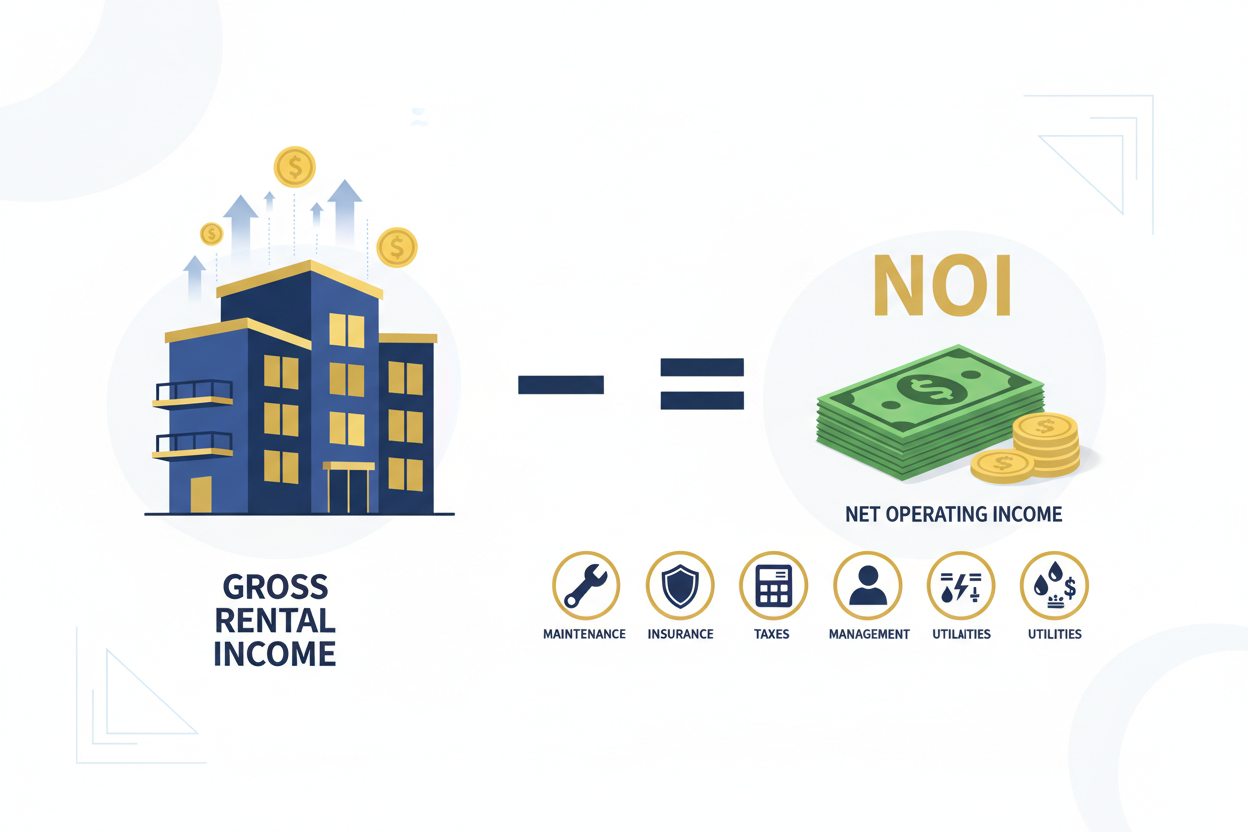
Net Operating Income (NOI) serves as your starting point. This figure represents the property’s annual income after operating expenses but before debt service and taxes. To calculate NOI, subtract all operating expenses from your gross rental income. Operating expenses typically include property management fees, maintenance costs, insurance, property taxes, and utilities paid by the landlord.
The capitalization rate, or cap rate, provides a quick snapshot of the property’s return on investment. You calculate this by dividing the NOI by the property’s purchase price or current market value. A 6% cap rate means the property generates 6 cents of NOI for every dollar invested. However, remember that cap rates vary significantly by market, property type, and quality.
Cash-on-cash return measures the annual cash flow relative to the actual cash invested. This metric is particularly important when using leverage, as it shows the return on your down payment rather than the total property value. A strong cash-on-cash return typically ranges from 8% to 12%, depending on the market and risk profile.
The debt service coverage ratio (DSCR) indicates whether the property generates sufficient income to cover loan payments. Lenders typically require a DSCR of at least 1.2, meaning the NOI should be 20% higher than the annual debt service. This buffer protects both you and the lender against income fluctuations.
Conducting Thorough Market Research and Due Diligence
Numbers only tell part of the story. Comprehensive market research provides the context needed to interpret those financial metrics accurately. Start by analyzing the local economic fundamentals that drive demand for commercial space in your target area.
Employment trends, population growth, and major employer presence all influence the health of commercial real estate markets. A market with diverse employment opportunities and growing population typically offers more stable rental demand than areas dependent on a single industry or employer.
Study comparable sales and rental rates in the immediate vicinity. Recent transactions provide insight into market values and trends, while current rental rates help you assess whether the subject property’s income is competitive. Pay attention to absorption rates and vacancy levels across different property types in the submarket.
Don’t overlook the importance of physical due diligence. Schedule professional inspections to identify potential capital expenditures that could impact your returns. Structural issues, HVAC system condition, roof integrity, and environmental concerns can all translate into significant unexpected costs if not properly evaluated upfront.
Review all existing leases carefully, paying attention to lease terms, tenant creditworthiness, and upcoming renewals or expirations. A property with strong, long-term tenants on favorable lease terms presents less risk than one with month-to-month tenants or upcoming lease rollovers.
Evaluating Property Cash Flow and Operating Expenses
Accurate cash flow analysis requires a detailed examination of both income and expenses. Start by creating a comprehensive rent roll that includes all current tenants, their lease terms, rental rates, and any additional income sources such as parking fees or common area maintenance charges.
When projecting future income, be conservative in your assumptions. Consider market rental rates for upcoming lease renewals, potential vacancy periods between tenants, and the likelihood of rent increases. Factor in the time and costs associated with tenant improvements and leasing commissions for new tenants.
Operating expenses deserve equal scrutiny. Request at least three years of operating statements to identify trends and unusual expenses. Common operating expenses include property management fees (typically 3-8% of gross income), insurance, property taxes, utilities, maintenance and repairs, landscaping, and professional services.
Create separate line items for recurring expenses versus capital improvements. While a new roof might be necessary, it’s a capital expenditure rather than an operating expense. Establish a reserve fund for future capital improvements – typically 5-10% of gross income – to ensure you’re prepared for major repairs or upgrades.
Don’t forget to account for vacancy and collection losses. Even in strong markets, some vacancy is inevitable due to tenant turnover, renovations, or economic downturns. A conservative vacancy assumption of 5-10% helps create more realistic cash flow projections.
Risk Assessment and Mitigation Strategies
Every commercial real estate investment carries inherent risks, and successful underwriting involves identifying, quantifying, and planning for these potential challenges. Market risk tops the list – economic downturns, industry changes, or shifts in consumer behavior can all impact property values and rental demand.
Tenant concentration risk becomes critical when a single tenant represents a large portion of the property’s income. If your largest tenant accounts for more than 30% of rental income, consider the implications of their potential departure. Strong tenant diversification provides more stable cash flow and reduces this risk.
Interest rate risk affects leveraged investments significantly. If you’re using variable-rate financing or planning to refinance during the hold period, rising interest rates could impact your returns. Consider interest rate hedging strategies or factor potential rate increases into your projections.
Physical and environmental risks require careful evaluation. Older buildings may face compliance issues with updated building codes or ADA requirements. Environmental contamination can create substantial liability and remediation costs. Professional inspections and environmental assessments help identify these risks early.
Liquidity risk in commercial real estate means you can’t quickly convert your investment to cash like publicly traded securities. Ensure your investment timeline aligns with your liquidity needs, and maintain adequate cash reserves for unexpected expenses or opportunities.
Technology and Tools for Modern Underwriting
Today’s commercial real estate professionals have access to sophisticated tools that streamline the underwriting process and improve analysis accuracy. Spreadsheet-based models remain popular for their flexibility, allowing you to customize calculations and scenarios specific to your investment criteria.
Specialized commercial real estate software platforms offer pre-built templates and advanced features like sensitivity analysis, scenario modeling, and automated report generation. These tools can save significant time while reducing the risk of calculation errors.
Market data platforms provide access to comparable sales, rental rates, and market trends that inform your assumptions. Services like CoStar, LoopNet, and local MLS systems offer valuable market intelligence that supports your underwriting decisions.
Financial modeling software allows you to test multiple scenarios and stress-test your assumptions. What happens if vacancy increases by 5%? How do rising interest rates affect your returns? These tools help you understand the sensitivity of your investment to various market conditions.
Don’t overlook the value of property management software in your analysis. Understanding the systems and processes used to manage the property can provide insights into operational efficiency and potential improvements that could enhance returns.
Common Underwriting Mistakes to Avoid
Even experienced investors can fall into common underwriting traps that lead to disappointing returns. Over-optimistic assumptions about rental growth, occupancy rates, or expense control often result in actual performance falling short of projections.
Failing to account for all expenses represents another frequent mistake. Items like tenant improvements, leasing commissions, and capital reserves are often underestimated or overlooked entirely. These costs can significantly impact your actual returns if not properly budgeted.
Neglecting market cycles can lead to poor timing decisions. Commercial real estate markets are cyclical, and purchasing at peak pricing with minimal due diligence often results in below-market returns. Understanding where the market sits in its cycle helps inform your investment strategy and pricing expectations.
Insufficient due diligence on tenants and leases can create unexpected challenges. A tenant’s financial strength, lease terms, and renewal probability all impact the property’s risk profile and value. Thorough tenant analysis prevents surprises that could affect your cash flow.
Finally, many investors underestimate the time and expertise required for active property management. If you plan to self-manage, ensure you have the skills and availability needed. If hiring professional management, factor these costs into your underwriting from the beginning.
Conclusion
Mastering commercial property underwriting is both an art and a science that requires combining analytical rigor with market intuition. The time invested in thorough analysis upfront pays dividends through better investment decisions and improved long-term returns.
Remember that underwriting is an iterative process that improves with experience. Each deal teaches valuable lessons about market dynamics, tenant behavior, and operational challenges that inform future investment decisions. Stay curious, remain conservative in your assumptions, and always verify the information provided by sellers and brokers.
Successful commercial real estate investing starts with solid underwriting fundamentals. By following the principles outlined in this guide and continuously refining your approach, you’ll be better positioned to identify profitable opportunities while avoiding costly mistakes. The commercial real estate market rewards those who do their homework – make sure your underwriting process gives you the competitive edge needed for long-term success.
Frequently Asked Questions
What is the most important metric in commercial real estate underwriting?
Net Operating Income (NOI) is typically considered the most important metric as it forms the foundation for calculating cap rates, cash-on-cash returns, and debt service coverage ratios. NOI represents the property’s income-generating ability after operating expenses.
How long should the underwriting process take for a commercial property?
The underwriting timeline varies by property complexity and size, but typically ranges from 2-6 weeks. Smaller properties might require 1-2 weeks, while large, complex deals could take 6-8 weeks or longer, especially if extensive due diligence is required.
What cap rate should I target for commercial real estate investments?
Target cap rates depend on property type, location, and risk profile. Generally, cap rates range from 4-10%, with prime properties in major markets typically offering lower cap rates (4-6%) while secondary markets or higher-risk properties may offer 7-10% or higher.
Should I hire professionals for the underwriting process?
For significant investments or complex properties, hiring professionals like commercial real estate brokers, appraisers, attorneys, and accountants is often worthwhile. Their expertise can help identify risks and opportunities that might be missed in self-directed analysis.
How do I account for future capital expenditures in my underwriting?
Create a capital reserve fund typically ranging from 5-15% of gross income, depending on the property’s age and condition. Additionally, schedule major items like roof replacement or HVAC upgrades based on their expected useful life and include these costs in your long-term cash flow projections.
What’s the difference between gross and net leases in underwriting?
Gross leases require landlords to pay most operating expenses, making expense management crucial to profitability. Net leases pass expenses to tenants, providing more predictable cash flow but requiring analysis of tenant creditworthiness and lease terms to ensure expense recovery.
Free Stuff!
Add CTA sections description.